Posts

Lessons From the Military on Improvement

Image
This article is about learning from "best-in-class" and applying the lessons to other industries. Although the title refers to the retail industry, the concepts apply across the board. In the civilian world we are simply using different names such as "servant leadership" and "cross training".  This is like bench-marking - look up and outside of your specific industry to see what the best are doing then borrow shamelessly to improve.     Read the article Read the Article                                                   
S&OP: What is it and Why Should You Care

Image
A nice thing about running one's own business is the ability to focus on areas of interest. For a long time, I had wanted to write practical articles of interest related to supply chain and operations. Now, I am able to so that. Thank you to ValveWorld for helping me achieve that goal. Here is a short introduction to S&OP - Sales & Operations Planning - a decision-making process that ensures that the tactical plans in all business functions are aligned and in support of the company strategy, business plans, and goals.  Lots of companies and people say that they do this but doing it well and regularly can pay terrific dividends. More articles will follow to guide you through a solid implementation. http://www.valve-world.net/webarticles/2019/06/17/sop-what-is-it-and-why-should-you-care.html

The Fourth Industrial Revolution: Some Supply Chain Managers Just Don’t Get It

Image
I just read an interesting article, with the above title, in SCMR (Supply Chain Management Review) online. The author talks about all the right stuff - independent processes and data points in the supply chain becoming a series of inter-connected nodes sharing real-time data. The revolution is coming but I think we need to be realistic about when it will arrive. I think it will arrive a widely different times for different firms and their industries. The Fortune 500 or Global 1000 will have a different timeline than the small-to-medium enterprise (SME). I spend a lot of time in the SME market space where I still see a large proportion of companies running major aspects of their business on MS-Excel, non-integrated software, and manual processes. While I believe in the technology and benefits of Supply Chain 4.0 in this article, and many similar ones, the company that is still doing a once-a-month update of inventory into their custom in-house MS-Access application or spreadshe...

BACK TO BASICS - IRA (Inventory Record Accuracy)

Image
BACK TO BASICS : I was a new hire with an organization that clearly had inventory management issues starting with poor product identification, no location control and a poor control of the manual wall-to-wall physical count compounded with the lack of an electronic system of record. That was nearly 30 years ago . Below is an excerpt from a white paper by ECI SOFTWARE from March of 2019. Hard to believe the following was identified as Pit Fall #1.  "Inventory record inaccuracies: ... Surprisingly, many Small-Medium-sized Manufacturers (SMMs) do not have inventory record-keeping policies and processes in place, including regular inventory counts, maintenance, and documentation. Results from a recent ECi Software Solutions’ customer “Warehouse Management Woes” survey shows that 53% of small to mid-sized businesses conduct manual inventory counts at least once a quarter and 50% of respondents have challenges counting or reconciling inventory." You cannot hav...

Zero-based Budgeting for Supply Chain

Image
We've all heard about ZBB (Zero-based Budgeting) but here is an article from McKinsey relating specifically to the supply chain. Take-away Even if you don't take this approach completely, reading the article may make you think about the concept and applying the idea to specific areas in a way that will work FOR YOU and your organization. We can start with smaller actions that are easy to get moving rather than getting bogged down with trying to wrap everyone's mind around the big topic - and the resulting inaction/inactivity. Start small - fail small - learn fast. If you are taking small steps, and fail then the failure likely won't have any significant repercussions while offering the benefit of both moving and learning fast. Pick yourself up, dust yourself off and start moving quickly again with the benefit of new information/experience. Zero-based productivity: Going granular and end-to-end across the supply chain

Everything old is new again: The 7 Principles of Supply Chain Management

Image
I get a lot of emails every day with tons of content. My job is to surf these topics and find the pearls of wisdom worth writing about and sharing. Today, I fell upon this article courtesy of Supply Chain 24/7 . The material concepts are so relevant that at first I thought it had been published recently. Reading through, it turns out this was published over 20 years ago. To me, that means that we, as supply chain professionals, still have a ways to go in instilling these concepts into daily practice at the organizations where we work. You should be able to read the summary with no  problems but you may need an account to download the full article. Click the highlighted text below. The 7 Principles of Supply Chain Management Principle 1 : Segment customers based on the ser­vice needs of distinct groups and adapt the supply chain to serve these segments profitably. Principle 2 : Customize the logistics network to the service requirements and profitability of customer s...

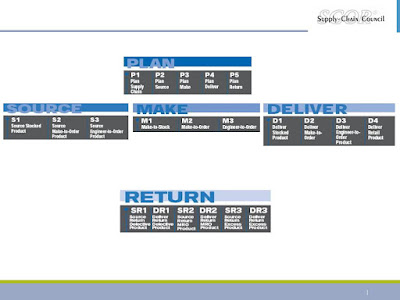
SCOR (Supply Chain Operations Reference) Model - is it too restrictive?

Image
I recently read this blog for Supply Chain Brain. Usually, I like what they have to say. This time, I agree with some of the points made such as the trend to economic nationalism impacting the supply chain, but i think this trend started before the political impact. Supply chains were being contracted, and relocated, to produce either where the raw materials were located or where the customers were located. For some fortunate few, those two locations were in the same geography. This is the "dig dirt where you sell dirt" concept. I don't agree with the comments made about the SCOR (Supply Chain Operations Reference) model. To me, it offers a documented structure of the overall process (plan-source-make-deliver-return-enable) along with some terrific guidance on metric selection, definitions and best practices. I don't think the model constrains or restricts people to silos and silo-thinking. It is up to leaders and managers to implement these elements where, and as...